I have been very busy and neglected this blog for a while.
I have finally achieved a S$1m net worth, which isn't a lot nowadays compared to the past. So much for toiling and going through BS in the past ~6.5 years.
See the breakdown here: https://my-radical-thoughts.blogspot.com/p/blog-page.html
The market and COE (Cat B and Open) have recovered considerably YTD, leading to an increase in the investment and car portions.
How do I feel about it? "Nonchalant" is the word. Due to my insatiable appetite for more $, I have already set myself a goal of earning another million.
I also feel like my life thus far is just all about working hard to chase after the dollar sign -- it seems nothing else is more important than having more $ in the bank.
Saturday, April 13, 2019
Tuesday, February 5, 2019
Tips on Saving $ and Expenses Update
Here's an uncommon tip to save $ for that once-in-a-life-time event: buy your wedding ring at a tax-free place -- Changi Airport. That's right, I did buy my ring there and saved 7% * $10,000 = $700 worth of GST. Plus you can accumulate iChangi points and use them to redeem for lounge access and Entertainer 1-for-1 membership.
Refer to a more detailed breakdown of my expenses.
My monthly expenses are still pretty much the same as ever, albeit with some slight changes after my wife moved in to stay put with me at my parents' place.
The usual expenses:
1. Eating out : We have to eat out for lunch/dinner during workdays and "date nights". We still stick to hawker food or Subway as cheap alternatives to restaurants. I estimate this to be $100-$150 per pax, barring any special occasions.
2. Groceries: I have greatly reduced my consumption of alcohol nowadays, thus saving about $20-$50 worth of beer each month. We spend < $100 each month on fruits, fresh cow and soya milk, and occasional snacks. To eat healthily, we consume more fruits and avoid foods with much preservatives, fats, sugar and salt, especially those instant and canned. Instant cup noodles used to be my favorite when I was a teenager, but now no longer.
We try to go for cheaper and nutritious fruits / veggies like baby carrots, oranges, watermelons, apples and bananas. And indulge in more expensive ones when there are promotions.
3. Phone bill: We both switched to SIM-only plans which are around $26 / month.
4. Car-related : About 2.5 petrol pumps on average per month cost ~$120 in total depending on the ever-fluctuating price. Another $80 for season parking at home and $110 at work.
5. Insurance: I pay ~$50 /month for AVIVA Term Life (Early CI and terminal CI)
Travelling : I always fly with budget airlines (e.g. Scoot, Jetstar) and book 3-star yet decent hotels through Agoda usually with 6% discount and try to eat cheap local food. I avoid expensive tourist traps.
With such minimal expenses, I find it hard to clock $500 on my UOB credit card to earn the bonus interest.
Monday, December 31, 2018
Net worth review 2018
As the year comes to an end, I have reviewed my net worth and reflected on my life and investing journey. My short investing journey began in 2016 with < 10k vested and in this year I have taken a much more serious tone towards portfolio management given the increased amount vested. I have learned much indeed in this turbulent market.
My net worth details : https://my-radical-thoughts.blogspot.com/p/blog-page.html
Portfolio details: https://my-radical-thoughts.blogspot.com/p/my-portfolio.html
Everything has been dropping this year: cryptos, COE, stocks, bonds. The unexpected COE downtrend has affected my car resale value.
I have screened more than 300 stocks in SGX this year and uncovered gems several of which I have done more in-depth studies and vested in them when their prices came down from the peaks.
I intend to hold for at least 5 years and hopefully I will be substantially rewarded.
Net worth comes from an above-average job, abnormally high savings rate and some other things.
Tuesday, December 11, 2018
High-level financial analysis of H-Trusts in SGX
In this article, I will look at the hospitality trusts (a.k.a. H-Trust) listed in SGX. Currently, there are 6 such H-Trusts, namely:
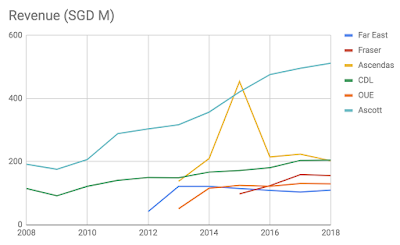
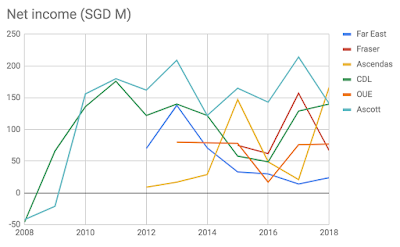
Even though Ascott has been growing its revenue strongly, its net income has been whipsawing over the years. The net income for CDL dipped before recovering lately.

1. Ascendas
2. CDL
3. Far East
4. Frasers
5. Ascott
6. OUE
I decided to do this exercise because they piqued my interest and I couldn't find any good comparison on the net.
Take note I will only look at them from a high-level point of view, as I have no time to dig into the details for each of them.
Ascott and CDL have been around for more than 10 years, so they have more data for us to make an accurate judgment, while the others are still relatively new. I assume all the data, taken from MorningStar and Dividends.sg, is correct (or at least roughly correct).
Revenue
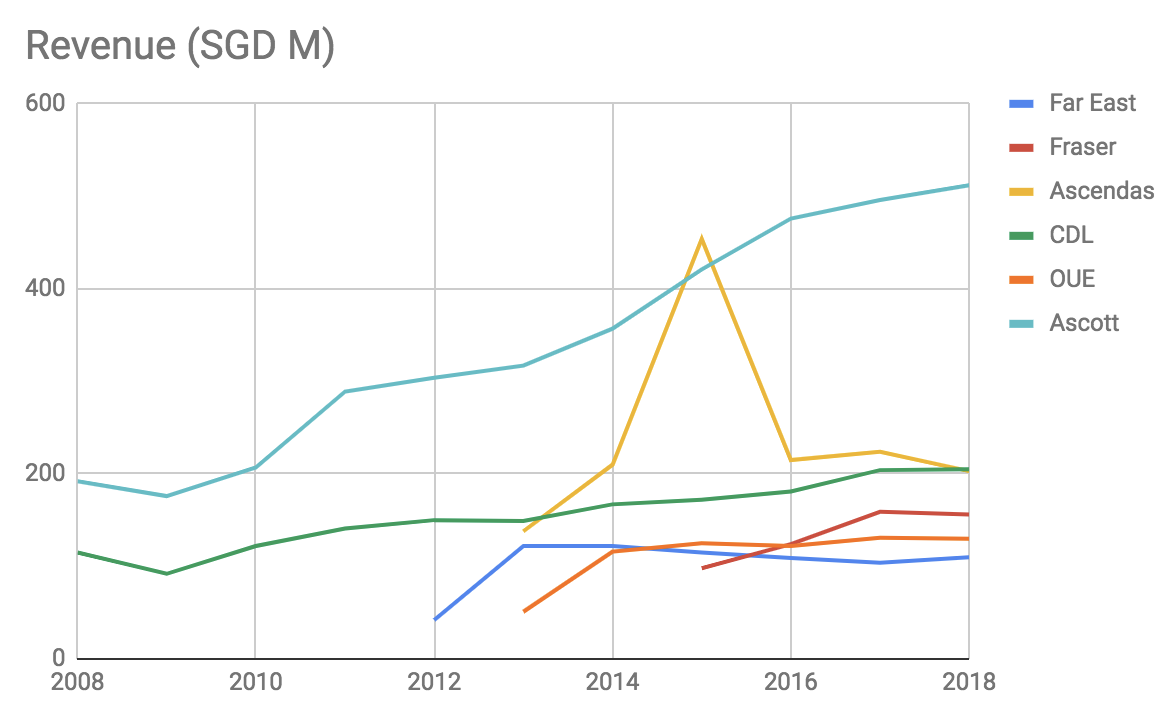
Ascott has been growing its revenue very well (~10% CARG from 2008-2018), while CDL is a much slower grower. For the rest, the revenue is quite flattish except for Ascendas and Fraser which showed some slight growth over the past few years. I don't think it's meaningful to calculate the CARG for the others as the timeframe is quite short.
Net Income
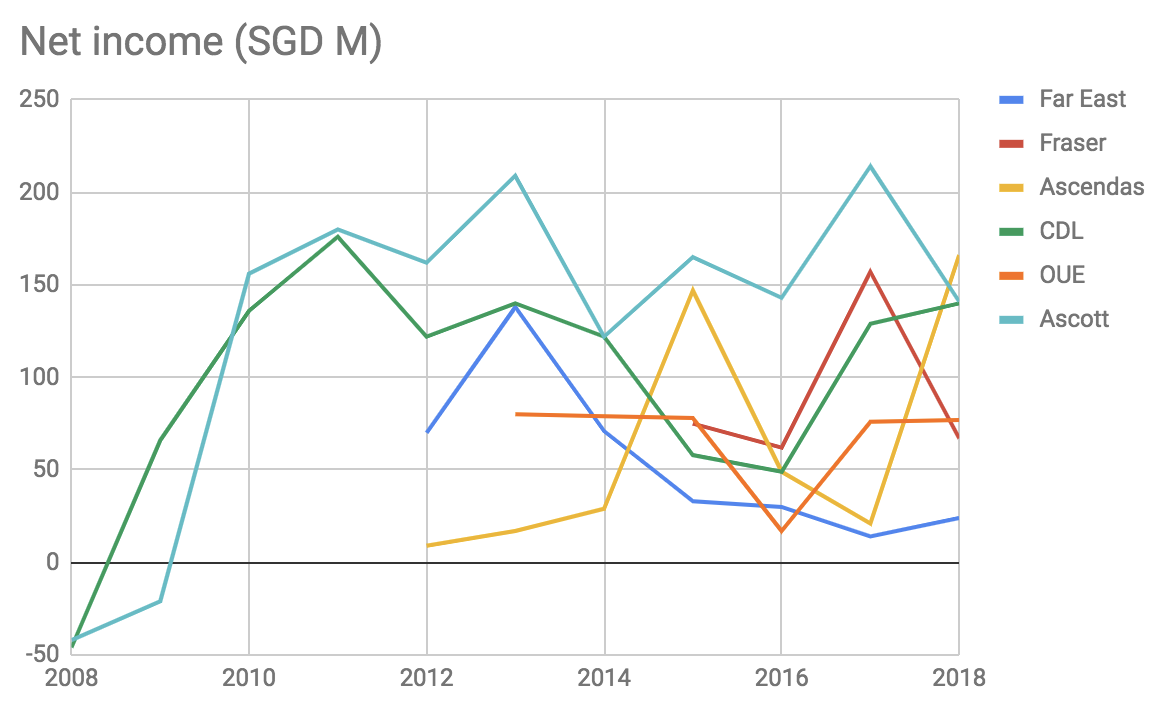
The net income chart shows a very different picture.
Even though Ascott has been growing its revenue strongly, its net income has been whipsawing over the years. The net income for CDL dipped before recovering lately.
During the GFC, the net income for CDL and Ascott went negative but quickly recovered.
The net income for Far East is on a downtrend while the net income for the rest is whipsawing.
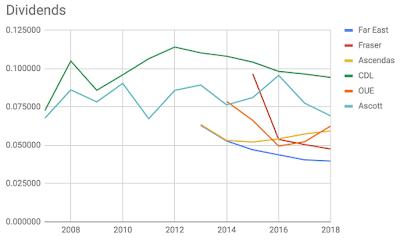
Dividends (DPU / S$ cent per share)
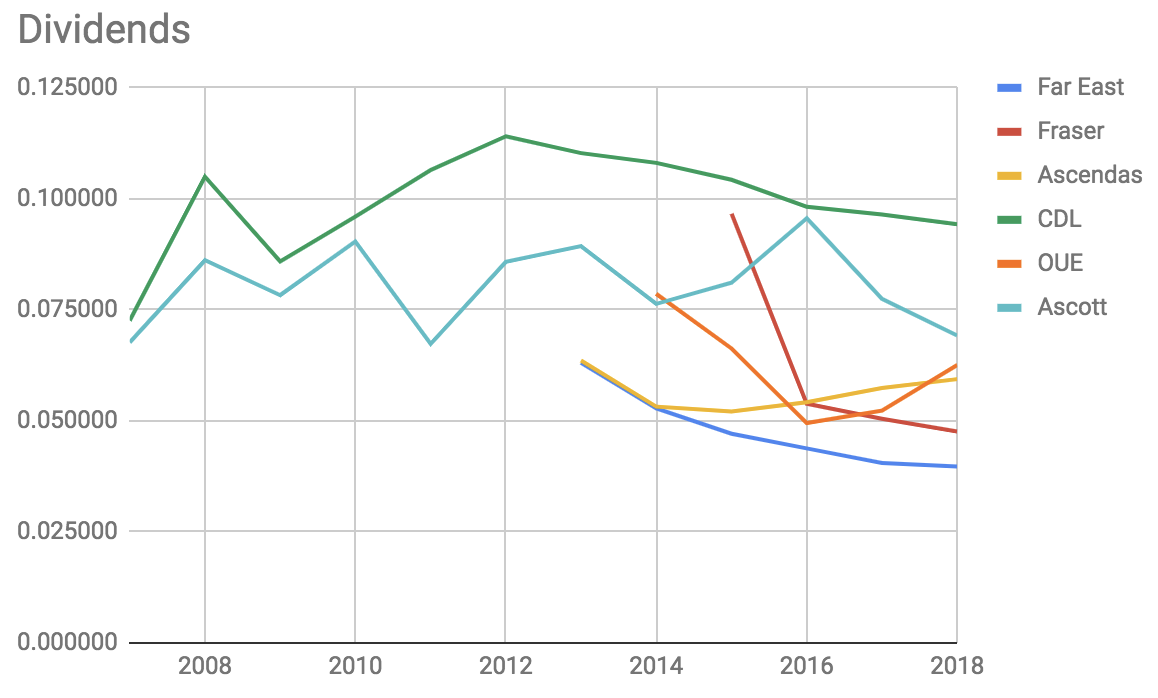
Now let us look at the dividends which is what many of us care about for investing in Trusts and REITs. As expected, the dividends correlate with the net incomes.
All show a downward trend except for Ascendas and Ascott, and a recovery is not in sight.
Only Ascendas shows an uptrend but the timeframe is too short to make any solid conclusion.
Rights Issues / Scrip Dividends / Private Placements
Above is the dividends table from which I plotted the dividends chart. Cells highlighted in pale orange mean there was at least one share dilution action in that year.
Ascott has the most number of share dilution action while Far East has none.
Price Action

I look at the price action to have a sense of which Trust gives the biggest capital gain since mid-2015 (around the time the newest Trust, Fraser, was listed).
Ascendas (Q1P dark purple line) gave the biggest gain and the rest are far from it.
Conclusion
To investigate further, one should look at other metrics such as the quality of assets, gearing ratio, RevPAR, and ADR.
However, based solely on the data above, if I were to make a choice, Ascendas does seem to be the overall winner here.
CDL and Ascott have lacklustre performance over the past 10 years.
Far East and OUE have poor performance as well in the past 5 years.
Welcome any feedback and opinions.
Saturday, December 8, 2018
REITS and Trusts to avoid
Investing in REITs is rewarding because of the juicy dividends. However, certain REITs have higher risks than others.
The market is forward-looking and very efficient in pricing equities and hence those REITs with yield > 7% usually have some inherent risks involved. Do not ever blindly invest in REITs with high dividends. The recent plunges in Asian Pay TV and others serve as a wake-up call / reminder to many of us.
Here, I will present a non-exhaustive list of REITs and Trusts that I will avoid. You may choose to disagree. I welcome any feedback. Typically once I see red flags such as short track record, consistently dropping DPU for a few years, unusually high gearing or concentration risks (e.g. tenant, geographical), I will avoid.
The market is pricing the REITS below with yields of between 6 and 10%, but I will not take the risk.
*Update*: I look at the business fundamentals only. Even if the NAV is very attractive or the price has reached 52-week low, I would not touch them until the fundamental improve. After all, the fundamental determine whether the dividend is sustainable.
For the following, I will avoid for now but I will continue to monitor their track record and even may start to invest in them once the red flags are gone.
The market is forward-looking and very efficient in pricing equities and hence those REITs with yield > 7% usually have some inherent risks involved. Do not ever blindly invest in REITs with high dividends. The recent plunges in Asian Pay TV and others serve as a wake-up call / reminder to many of us.
Here, I will present a non-exhaustive list of REITs and Trusts that I will avoid. You may choose to disagree. I welcome any feedback. Typically once I see red flags such as short track record, consistently dropping DPU for a few years, unusually high gearing or concentration risks (e.g. tenant, geographical), I will avoid.
The market is pricing the REITS below with yields of between 6 and 10%, but I will not take the risk.
*Update*: I look at the business fundamentals only. Even if the NAV is very attractive or the price has reached 52-week low, I would not touch them until the fundamental improve. After all, the fundamental determine whether the dividend is sustainable.
For the following, I will avoid for now but I will continue to monitor their track record and even may start to invest in them once the red flags are gone.
Tuesday, October 16, 2018
Optimise living expenses Part 1
I am a true-blue minimalist in that I only buy things that are necessary. However, I do own a car 'cos I am tired of taking public transport to/fro my home in one of the most populous areas in Singapore. Another reason is I can afford to do so :) My annual income can buy an entry level car with COE included. You can read about it here
Let me share with you how I optimise my expenses in various areas without sacrificing much qualify of life. Sometimes I'd only give a broad guidance and won't go into the details.
Entertainment:
Let me share with you how I optimise my expenses in various areas without sacrificing much qualify of life. Sometimes I'd only give a broad guidance and won't go into the details.
Entertainment:
- I used to buy HSBC movie cards (for HSBC card owners only) which are just stored-value cards that allow purchasing of a fixed number of tickets online/offline at a discounted price. I'm not sure whether GV still offers it.
- I stopped buying those cards until I realised I can watch on weekdays at the lowest price. A typical 2D movie costs $6.50-$7.50 at GV per pax on weekdays. On weekends it can go up to $13! Some credit cards offer a slight discount and you can even get cashback on ShopBack.
- You can take up the free GV membership which offers perks and 1-for-1 tickets during your birthday month.
- Don't buy the over-priced and low-quality food at the cinema.
- To take it further, you can go for the cheapest Netflix subscription at only $10+/month but the latest movies won't be available. You can get a free 2-month Netflix subscription by signing up to be a LiveUp member via Lazada, etc.
- KTV: Well you can go to Civil Service Club, Teoheng and those not-as-branded ones. The prices should be cheap during off-peak hours. However, do note that CSC might not have the latest songs.
- Take advantage of corporate scheme discounts and reimbursements.
- You can subscribe to $20/month SIM-only plans -- if you don't want a new phone with a 2-year contract. A SIM-only plan is quite decent given the price. For example, Singtel offers 3 GB (no talktime, no SMS, no caller ID) for $20. You can add on 200-min talktime and Caller ID for only $5 / month each. I don't think anyone needs SMS. With a 12-month contract, the same SIM-only plan offers more perks: 5GB, 150 min and 500 SMS.
- Alternatively, you can get a new phone with contract and sell the phone at slightly below retail price to earn about $100-$200 one-off depending on the phone and selling price. However, this comes with a risk of not being able to sell the phone.
- You can also try cheaper telcos such as zero1 and Circles.Life with better perks and lower prices. They have no physical shops to save on operating costs. However, be prepared the customer service may take a long time to reply you. Well after all they have to cut costs somewhere to pass on the savings to you right? Both virtual telcos lease infra from M1 so the coverage is the same as M1's. But of course, SingTel offers the widest coverage with free ST WiFi at many locations.
- I personally have been a long-time SingTel customer. After my contract ended, I switched to SIM-only $20 + $5 for 200-min talktime. I don't have caller ID so I risk picking up overseas spam calls. Now I am contemplating swapping talktime for caller ID. I rather pay $0.16 / min (as-charged) for talktime as I usually use data to call people. I hardly use SMS and it costs only $0.05 / SMS anyway.
- Try to buy during sales periods such as Black Friday, Cyber Monday when steep discounts are offered. However, the best policy is to curb the urge to buy. Ask yourself whether it is truly necessary. I have lived pretty well with just a phone and laptop for many years.
- Don't chase the latest trends. Usually a gadget can last for pretty long, at least 5 years in my experience. So far my external harddisk and laptop have no problems. For a phone you can change the battery and it will be like-new again.
- I personally use iPhone as I prefer paying a premium for quality phones (compared to Xiaomi, etc.). The screen size is also just nice for my jeans pocket. Ladies usually prefer the Plus version 'cos they put in their bags instead of pockets. It has been 2 years now and I intend to change the battery to use it for a few more years.
Tuesday, August 14, 2018
Reflection on owning a car in the most expensive city
Previous articles:
I have shared some tips both car and non-car related on my blog:
Minimising car expenses
My Expenses
I also shared my rationale for buying a car:
Saving money on car ownership in Singapore
I am quite frugal excluding the owning of a car.
Having a car is great. It gives you freedom and a sense of control if you like driving.
It also allows you to explore remote and unique/interesting places.
feel free to ask me more questions on money-saving tips. I consider myself an expert in saving money and exploiting systems heh, still while enjoying life.
Last time I also thought that I could taxi everywhere which is still cheaper than owning a car. But over time after I built up my savings and grew discontented with public transport, I decided to buy one.
If you ask me whether I regretted buying, I'd say partially, due to the COE dropped quite a fair bit, causing more depreciation to my car. Other than that, I'm very satisfied and I'd say my quality of life has improved. Barring accidents on the road, and rare traffic congestions, the car has greatly reduced my commuting time to/fro work by 30-50% depending on the traffic condition. This is much better than taking MRT and buses, having to stand and squeeze with others.
The best time to buy a car is probably during a recession, like stocks, lol.
Once you own a car, you wouldn't feel like going back to taxi/public transport, even despite the high cost of ownership.
Not to mention having a car helps in getting you the girl.
Subscribe to:
Posts (Atom)
-
 There are numerous debate on this topic. I have been a cashback person all the while and recently have been wondering whether it's wort...
 -
Nowadays you can't avoid seeing the word "AI". AI is everywhere. Every company is rapidly adopting AI. Google today just relea...
-
I have been very busy and neglected this blog for a while. I have finally achieved a S$1m net worth, which isn't a lot nowadays compar...